
Find People Through Los Angeles County Records
The best starting point depends on what is known. A full name can lead to Los Angeles County court cases, deeds, licenses, business filings, or unclaimed property. An address belongs first in the Assessor Portal, where it can yield an Assessor Identification Number, or AIN. An older address may work better in the Los Angeles Public Library directory collection. Family events call for vital indexes, probate cases, obituaries, and certified-copy channels.
Keep the trail narrow. Los Angeles County has many people with similar names, and a single result rarely proves identity. Compare middle initials, filing places, dates, business names, parcel numbers, and related parties. Then confirm the useful match with the office that holds the source.
- Write down the exact name, known date range, address, or business link.
- Choose the official index that searches that fact rather than browsing every database.
- Record the case, document, parcel, license, or entity number from a likely match.
- Use that identifier to open the fuller record or request a copy from its custodian.
- Cross-check one more official source before treating two records as the same person.
Los Angeles County Search Custodians
The Los Angeles County Registrar-Recorder/County Clerk combines recorder, county clerk, vital-record, voter, and elections functions. That explains why a lavote.gov address can lead to deeds or birth copies as well as election services. The Assessor keeps the parcel side of a property trail, while the Superior Court keeps case indexes and files. Each office answers a different question. Detailed access rules and request steps belong with the Los Angeles County public records system.
Los Angeles County Assessor
500 West Temple Street, Room 225
Los Angeles, CA 90012
(213) 974-3211
Los Angeles County Deed Search Depth
Recorded land documents form the oldest continuous Los Angeles County people-search trail in the research. RR/CC keeps real estate records from 1851 to the present. The public online grantor and grantee index identified in the county research begins in 1977, while its AIN method begins after September 2009. A grantor is a party transferring an interest. A grantee receives it. Both can be people, trusts, or businesses.
This split in coverage is easy to miss. A blank web result does not show that no deed exists. For older work, use the alphabetical name-and-year indexes at Norwalk. Records from 1851 through 1957 are reviewed on the lower level; records from 1958 forward are reviewed on the second floor. RR/CC does not perform index searches by telephone.
Recorded instruments can connect a Los Angeles County name to far more than a sale. Grant deeds and quitclaim deeds show transfers. Deeds of trust, reconveyances, assignments, liens, notices of default, trustee's deeds, easements, affidavits, and powers of attorney can place other parties in the same property trail. Treat the index description as a lead, then request the recorded instrument when its wording matters. Plain copies cost $5 for the first page and $3 for each added page by the researched mail schedule. Certified copies cost $6 for the first page and $3 for each added page. A mailed name-and-year search costs 50 cents per name per year, with a $1 minimum.
| Search route | Field | Los Angeles coverage |
|---|---|---|
| Grantor or grantee | Person or company name | 1977 forward online; 1851 forward in office |
| AIN | 10 digits without dashes | Documents after September 2009 |
| Document number | Known recording identifier | Direct record lookup |
Note: Call RR/CC for procedure questions, but plan an online, mail, or counter route for the actual Los Angeles County index search.
Search Los Angeles County Court Names
The Superior Court party-name service searches civil, small claims, family law, and probate litigants. A result can show the litigant name, case type, filing date, filing location, and count of available document images. Filing location is especially useful across a county with many courthouses. The service is updated daily, but it charges for name searches. Public courthouse terminals offer another access channel.
The online date line changes by case class. Unlimited civil, probate, and family law reach back to 1983. Limited civil starts in 1991, and small claims starts in 1992. Older files require an Archives availability check. Sealed matters and confidential case types remain outside ordinary public access.
The Los Angeles Superior Court civil name-search page shows the scope and fee structure used for party research.
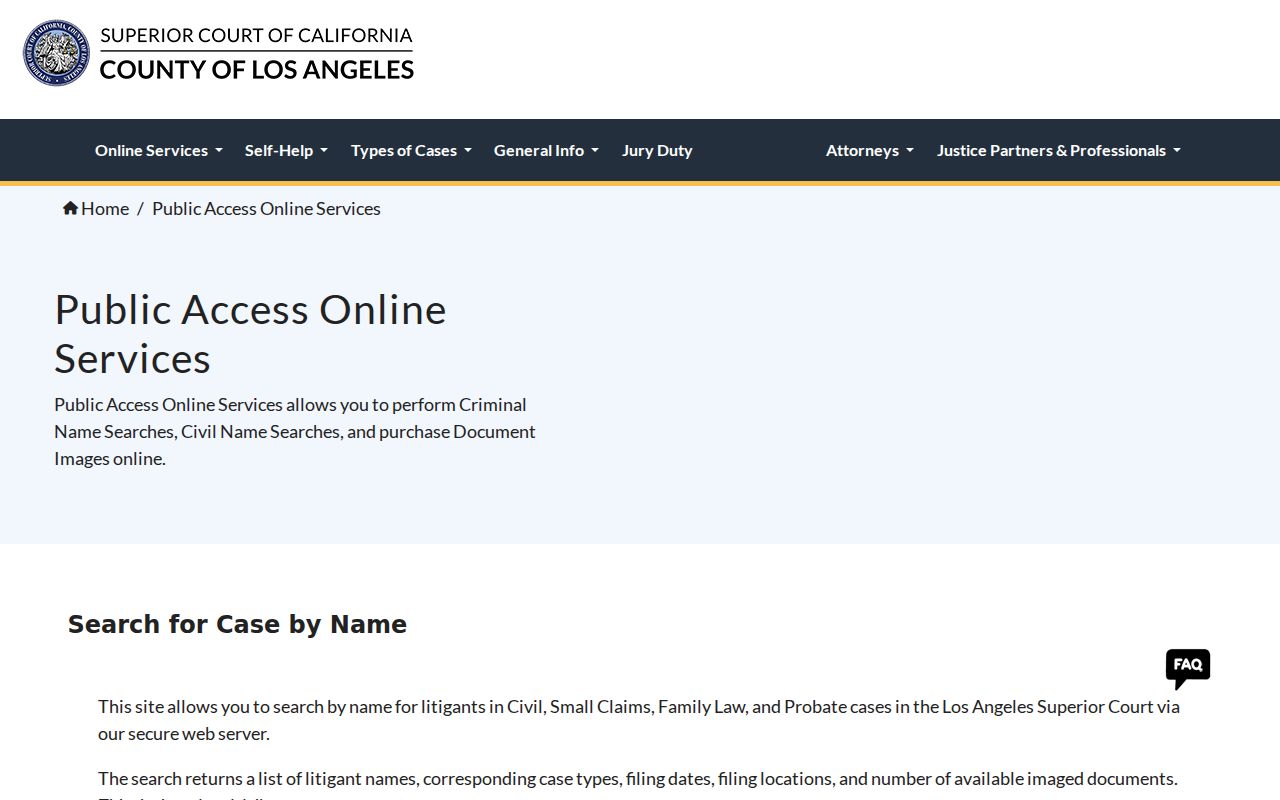
The service description makes clear that a name search is an index step. The case number and filing court then lead to more direct case access.
Los Angeles County Court Services
Los Angeles County court research does not end at the civil index. Public Access Online Services also routes users to criminal case summaries, defendant-name search, family law, probate, small claims, traffic, calendars, and document-image tools. Criminal cases may be searched by a person's name or case number online, or through public terminals inside a courthouse. Exact availability still depends on the case and its access status.
The court's public-access services screen separates these record paths.
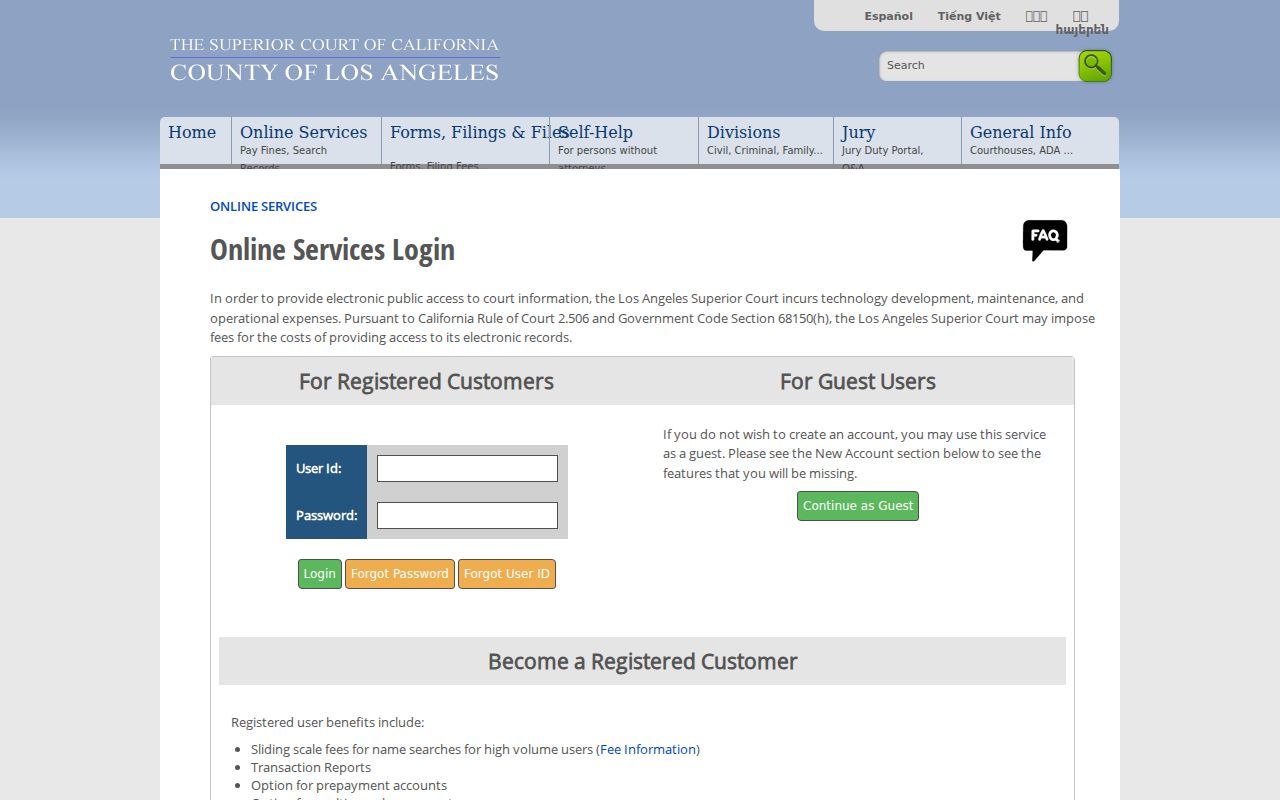
Choosing the case type first avoids forcing a probate, criminal, or traffic question through the civil name-search form.
Turn Los Angeles County Addresses Into Parcels
A known address can be more precise than a common name. The Los Angeles County Assessor Portal accepts an AIN or address and provides parcel and assessment details. Its map route adds parcel, city, community, ZIP Code, school district, and supervisorial district layers. Those boundaries help decide whether a municipal department or a county agency keeps the next record. A postal address that says Los Angeles does not always fall within the City of Los Angeles.
Use the parcel number to bridge an address search into the deed index. The sequence is simple: address to assessor record, assessor record to AIN, AIN or owner clue to recorded documents, and recorded parties to earlier transfers. For deeds before the AIN index period, switch to grantor/grantee names and document references.
The Los Angeles County Assessor Portal is the official first stop for this workflow.
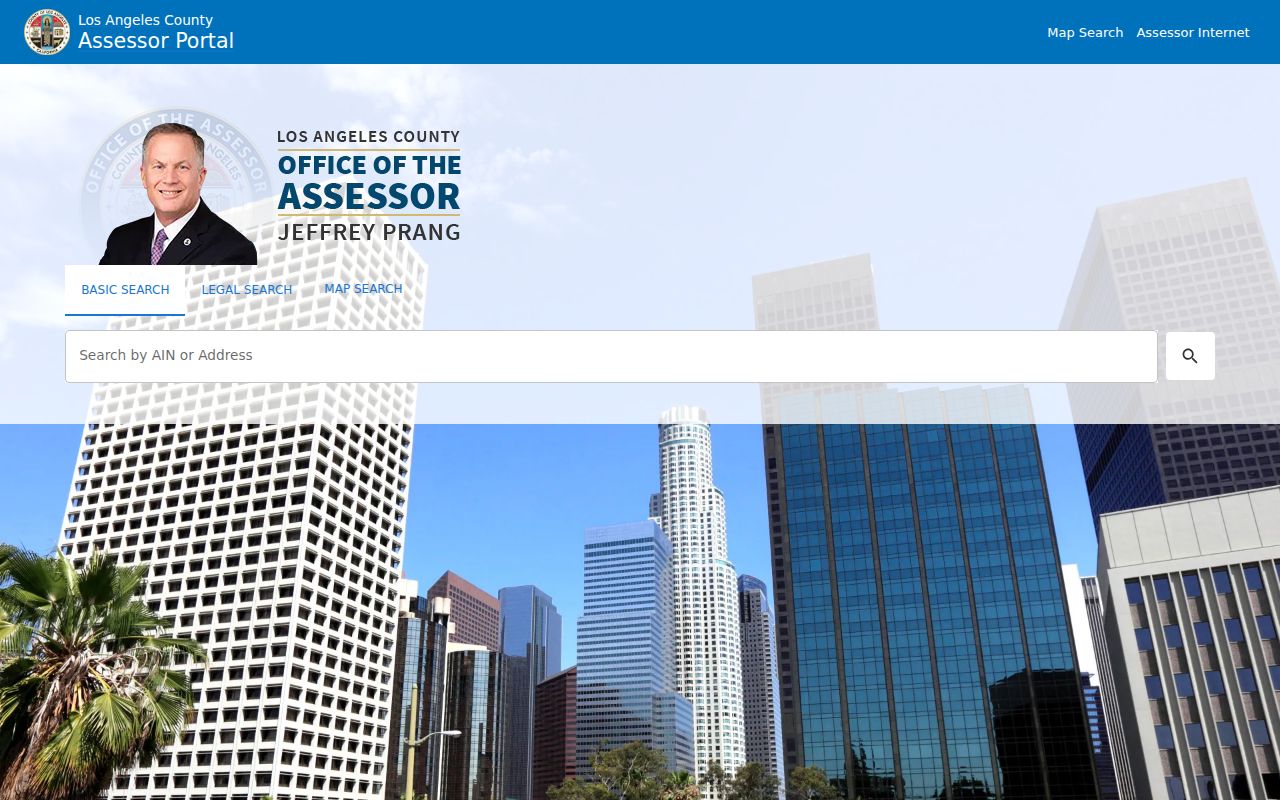
The portal's AIN and address choices show why it is strongest when a place, rather than an owner's name, is already known.
Los Angeles County Vital Record Paths
RR/CC issues Los Angeles County birth, death, and marriage copies. It maintains county birth records from 1866. The online application lists certified-copy fees of $34 for birth, $26 for death, and $19 for marriage. California also separates authorized certified copies from informational certified copies. An authorized birth or public marriage copy may require eligible status and a notarized Certificate of Identity. An informational copy carries a warning that it cannot establish identity.
Confidential marriage records follow a stricter rule. Only a party to the marriage or a person with a court order may obtain one, and there is no informational-copy option. Divorce files belong to Superior Court, even though state vital-record channels may hold limited divorce records for certain purposes. Older transferred divorce files may require Court Archives.
- Certified copy
- An official copy issued by the custodian, sometimes limited to eligible requesters.
- Informational copy
- A certified vital-record copy marked as unusable to prove identity.
- Index
- A finding aid that points to a record but is not the record itself.
Los Angeles County Voter Lookup Limits
The Los Angeles County voter tool is a self-verification service, not an open address directory. It requires a last name, birthdate, residence house number, and ZIP Code. California treats home address, phone number, email address, precinct or registration number, and prior registration information as confidential except under the limited uses allowed by Elections Code section 2194. That design prevents casual name browsing.
The distinction matters in a Los Angeles County people search. Voter status can help a voter confirm their own registration and election information, but it should not be treated as a route to another person's home address. Formal voter-information requests use a separate county process, fees, and statutory restrictions described on the voter registration page.
Use Los Angeles County records only for lawful personal research. Never use restricted or public information to stalk, threaten, or harass anyone.
Trace Los Angeles County Business Names
Business and license records help when a person used a trade name, professional credential, or company address. Los Angeles County Fictitious Business Name data covers current statements from February 2024 forward and can be searched by business name, city, ZIP Code, and more. Older FBN records need RR/CC channels and may also leave newspaper-publication traces.
At the state level, bizfile searches corporations, limited liability companies, and limited partnerships. The separate UCC service can search debtor name, secured-party name, or file number. Department of Consumer Affairs License Search reports whether covered licenses are current, expired, suspended, or revoked, though some boards use separate systems.
The California DCA license lookup displays its status and discipline scope before a search.
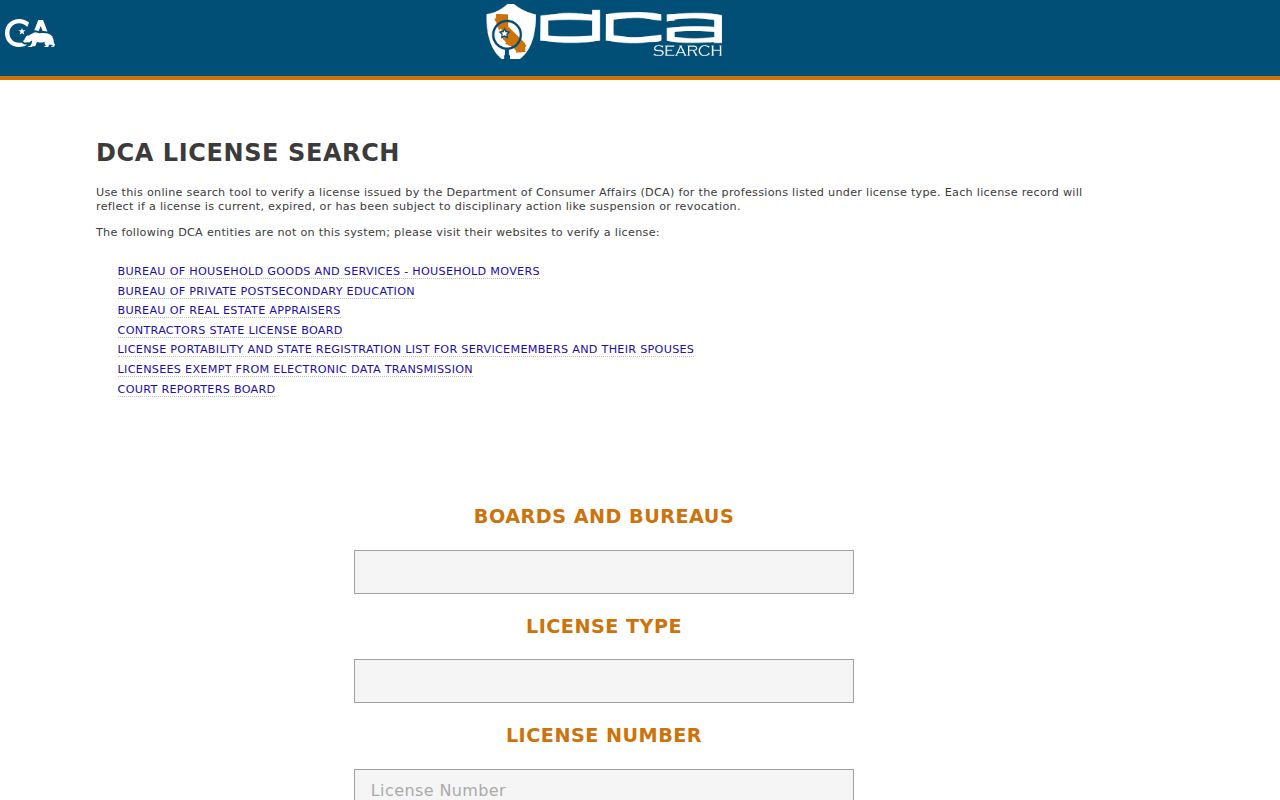
A license result is best used as one verified link among a name, credential, board, and public address of record.
Los Angeles County Government Directory Clues
Public staff and office directories answer a narrower question than residential sources. The City of Los Angeles directory lists elected officials, departments, bureaus, boards, and commissions with website, email, phone, and social links. City Planning adds a staff search by name, title, or division. County department pages identify department heads and public contact channels, while California's Personnel Office Directory lists personnel-office contacts rather than every state worker.
The City of Los Angeles directory shows the department and official fields used for current civic contacts.
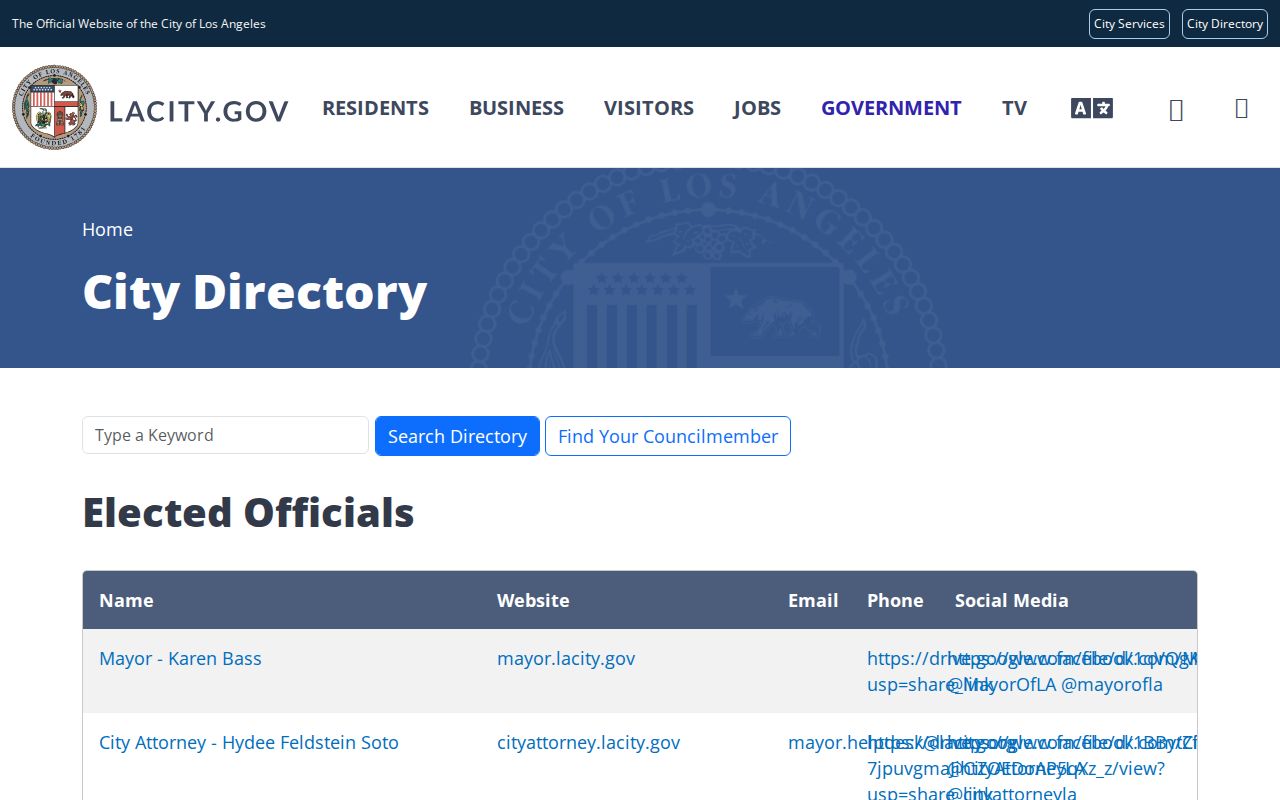
These entries identify a public role and office. They should not be read as home or personal contact records.
Free and Paid Los Angeles County Searches
Official does not always mean free, and free does not always mean complete. Assessor maps, many license and business searches, unclaimed property, public directories, and library scans are free to search. Superior Court party-name searches charge electronic access fees. RR/CC charges for plain and certified copies, and vital copies carry set fees. In-person indexes may reveal older coverage that the web lacks.
| Source type | Best use | Main limit |
|---|---|---|
| Official online index | Verified identifiers and current access rules | May stop at an index or recent date |
| Office or archive | Older files, copies, and records not online | May require a visit, request, or fee |
| Commercial compilation | Broad lead gathering | Not the custodian; data may be stale or merged |
For proof, return to the county, court, state agency, or library that owns the underlying record.
Los Angeles County Historical People Search
The Los Angeles Public Library has an exceptional bridge between a name and an old address. Its digitized Los Angeles-area city and street-address directories span 1875 through 1987. Reverse directories support address-to-occupant work for 1906, 1927, and 1956 through 1987. They can reveal residents, businesses, occupations, spouse references, and changes over time. The library's broader genealogy collection covers census sources, newspapers, obituaries, immigration, military records, family histories, and vital indexes.
Start an old-address search in the period directory before applying modern parcel geography. Street labels, community names, and city limits can shift. After identifying an occupant, compare the name against deeds, death indexes, probate filings, naturalization records, and newspapers. California State Archives adds Great Registers, probate, court, deed, vital, and naturalization holdings. Los Angeles County Superior Court naturalization records at the National Archives are not yet digitized, so offline research still matters.
The media divide is part of Los Angeles County records history. The county was formed in 1850, real estate records start in 1851, and the library's individual directory titles reach into the 1870s. Yet the major online deed and court name indexes begin much later. The Registrar of Voters and County Recorder merged in 1968; nonjudicial County Clerk functions joined the department in 1991. That merged office moved to one headquarters in 1993. Deep coverage and recent web coverage can therefore coexist in the same Los Angeles search. When a date falls before an online cutoff, move to a library, archives, or the Norwalk counter rather than changing the spelling until a result appears.
The LAPL city and street-directory collection introduces the searchable date span.
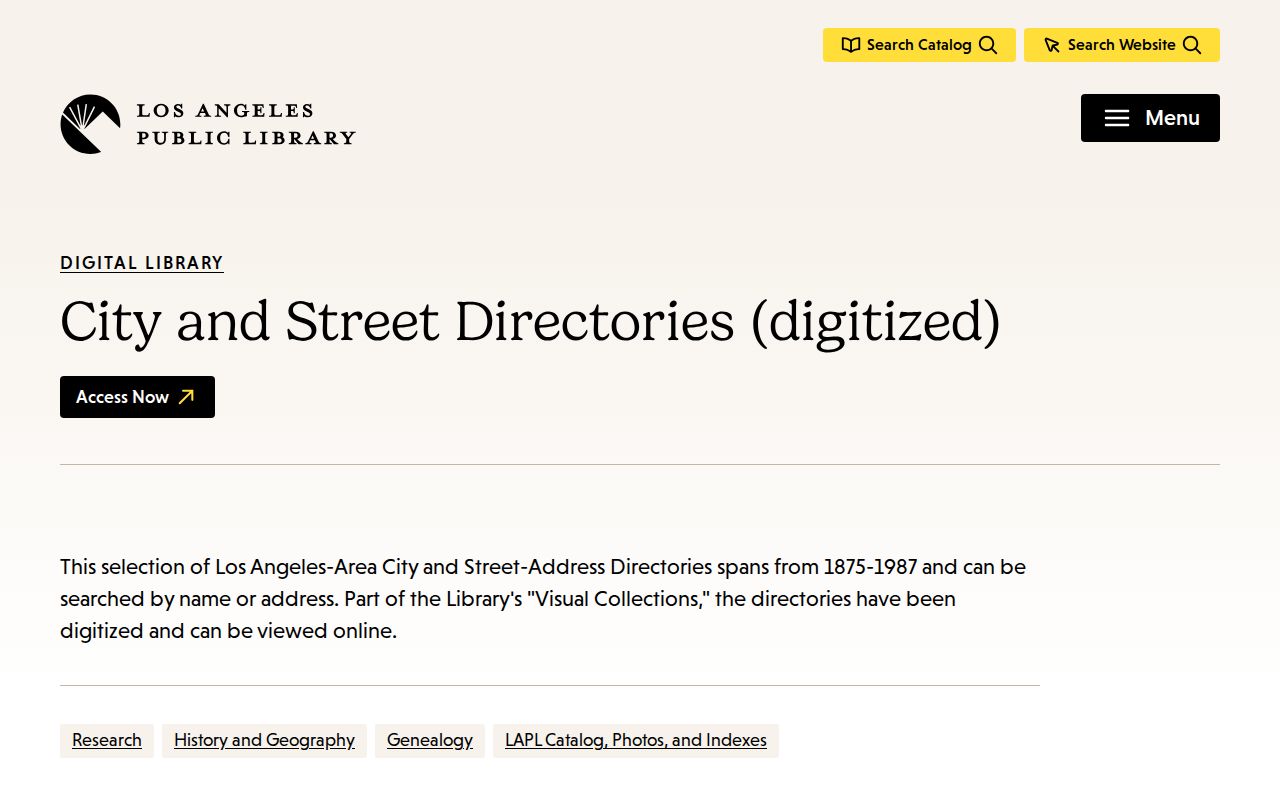
The collection provides both name-to-address and address-to-occupant routes, which is rare among modern public databases.
Los Angeles County Custody Records
Current custody questions belong in the Los Angeles County Sheriff's Department Inmate Information Center. California prison custody belongs in CDCR's CIRIS search, and federal custody belongs in the Bureau of Prisons locator. These systems cover different jurisdictions, so a blank result in one does not answer the others. Police reports follow separate eligibility and records-request rules; they are not the same as an inmate locator.
California's Megan's Law website publishes only information the law permits. Some registrants are not posted, and some location information appears only at ZIP-Code level. Absence from the public site does not prove that no registration record exists. Registry data must never be used to harass or threaten a person.
For consumer safety, official records also expose common scam checks. California unclaimed property claims carry no state deadline and no claim fee. RR/CC deed copies cost far less than many official-looking private solicitations. Verify a jury, warrant, deed, or property demand through the named government office before paying anyone.